Current Research Projects
Below you’ll find a list of research projects our team are currently working on. You may as well read about our past projects.
Mathematical modeling of developing muscles
Amirali Zandieh, Abhinav Kumar, Francine Kolley
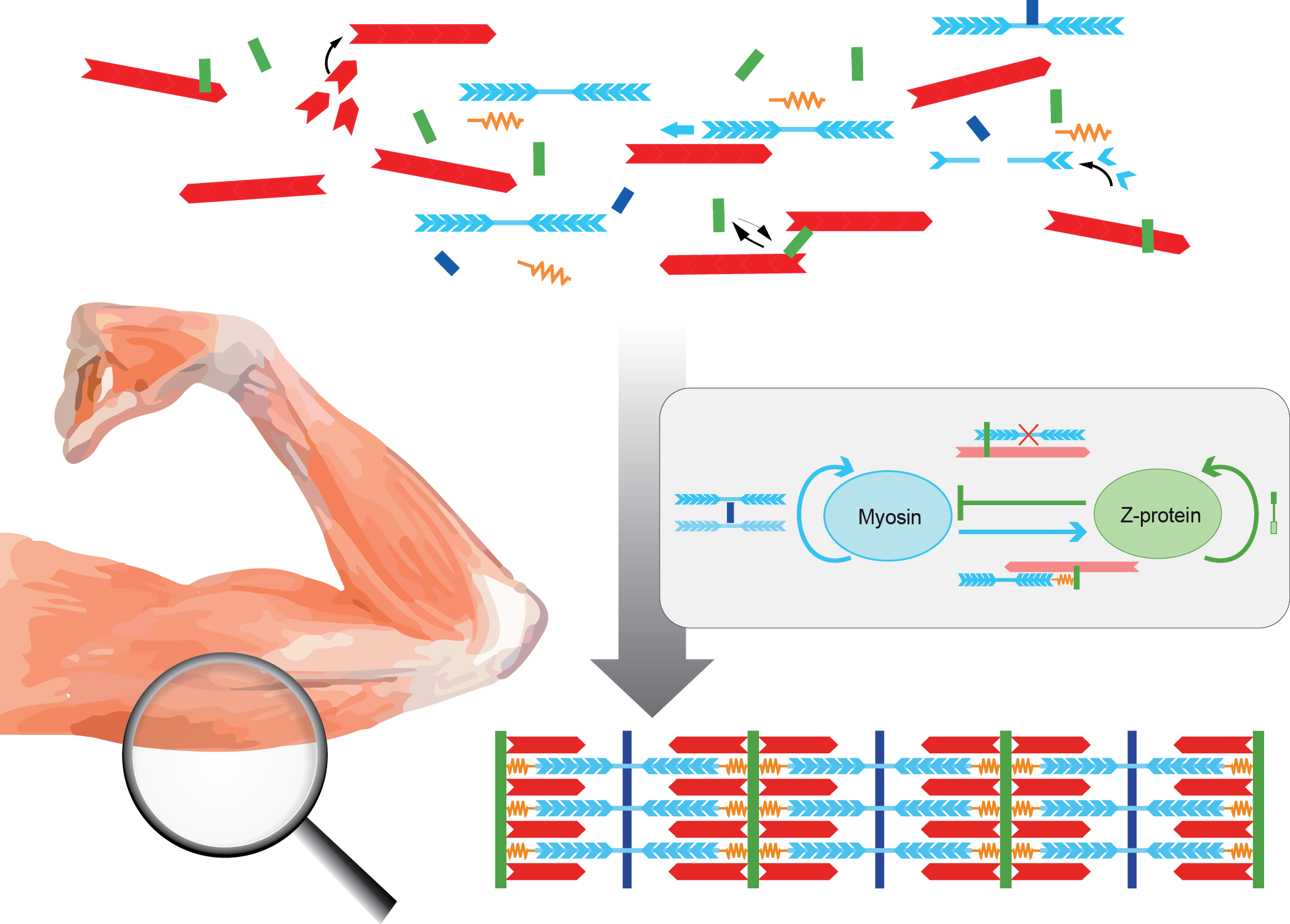
How to build a muscle? Striated muscles are organized in pseudo-crystalline structures, called sarcomeres. They contain three different types of filaments. Sarcomeres consist of polar actin filaments crosslinked at their structural plus ends to the Z-disc, while their minus ends face the center of the sarcomere, where they interact with anchored bipolar myosin molecular motors. The giant protein Titin serves as an elastic spring that links the actin and myosin filaments. We do not understand how these elaborate structures self-assemble during muscle development.
We develop theoretical models of how cytoskeletal filaments in an initial disordered acto-myosin bundle interactions spontaneously form periodic patterns and, eventually, highly regular sarcomeres. Our approach combines mean-field models and agent-based simulations to investigate two putative mechanisms of myofibrillogenesis.
Read more:
Biomineral pattern formation in diatoms
Francesco Leone
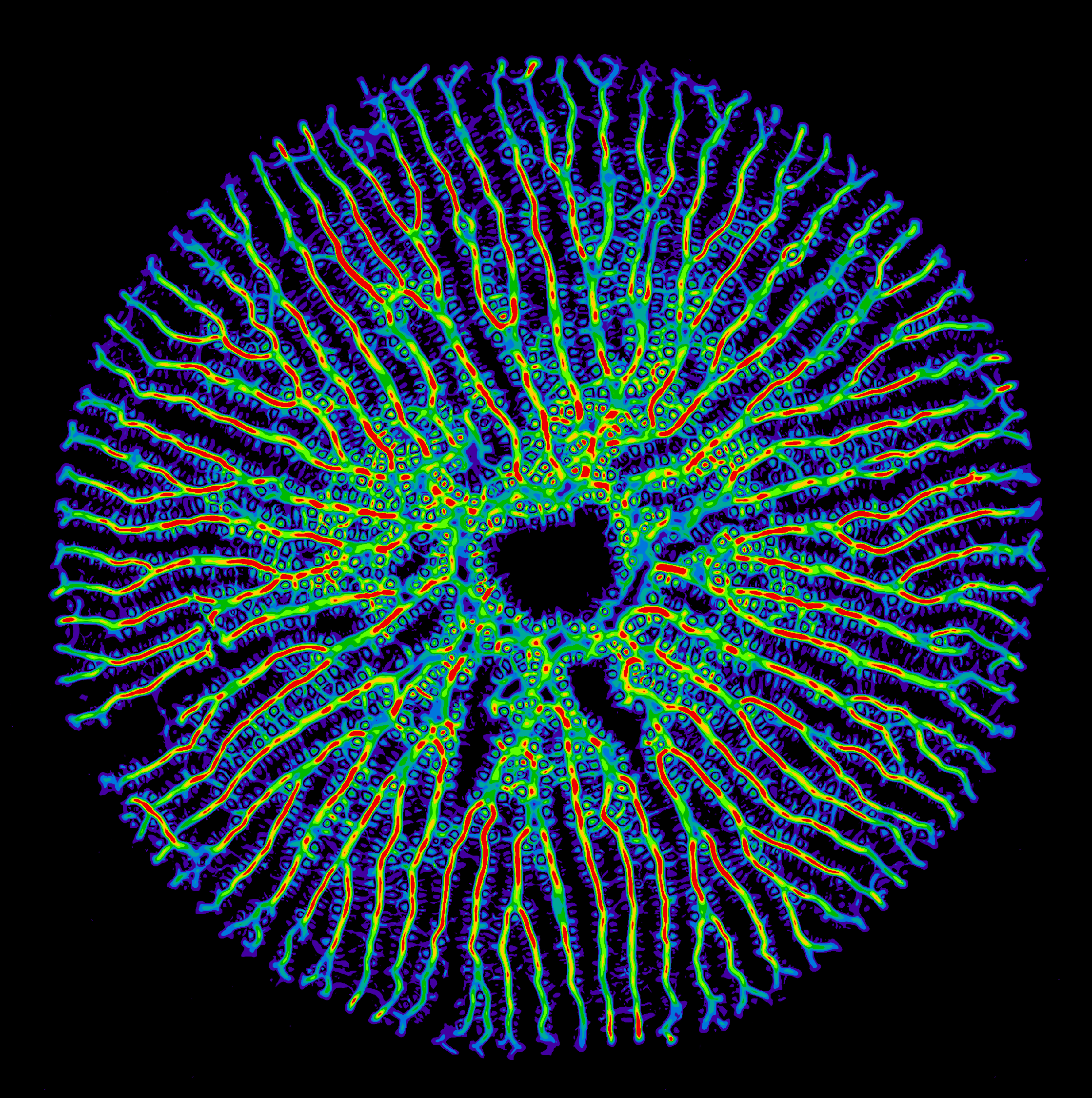
The formation of minerals by living organisms is widespread across the tree of life. How organisms harness physics to build species-specific biomineral architectures with outstanding material properties inaccessible to material science, remains open. The ornate silica-based cell walls of diatom microalgae represent an ideal system to understand biomineral morphogenesis. Using recent advances in imaging nascent diatom silica and known silica chemistry, the Friedrich group developed the first mathematical model that quantitatively explains the formation of branched silica rib patterns. In my PhD, I want to understand how these rib patterns interact with other pattern features, such as regular patterns of nano-pores using the model diatom Cyclotella nana. While multiple mathematical models can explain the wildtype pattern, novel mutants allow to discriminate between different physical mechanisms.
Read more:
Physical principles of pattern scaling during fin regeneration in zebrafish
Maximilian Kotz
The zebrafish is known for its ability to regenerate lost body parts, including fins. The pectoral fin of larval zebrafish is an ideal model system for studying regeneration because it can be easily manipulated, is amenable to high-resolution imaging and its regeneration is fast. We are close collaborating with the Rita Mateus lab, (Physics of Life, TU Dresden) to understand principles of regeneration, growth, and size control.
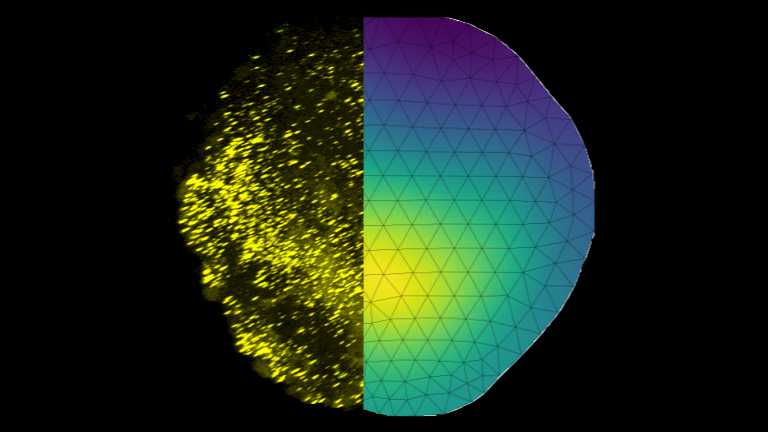
Our theoretical research aims to develop mathematical models to understand the role of BMP morphogen gradients regulating fin growth. The ability of gradients to scale with the size of the tissue seems to be one key aspect of robust growth. Within two days, the size of the fin can double, with final size controlled precise up to a few percent.
The methods we use include analyzing fluorescence images, building mathematical models, e.g., reaction-diffusion models in several dimensions, and iteratively refining these models guided by data. Ultimately, we aim to understand physical principles guiding regeneration.
Cellular navigation
Julian Rode
Biological system process information despite noise-corrupted input, often operating at limits imposed by physics. A prime example is chemotaxis, i.e., active navigation in spatial fields of chemical cues, which enables immune cells to find inflammation sites, sperm cells to find the egg, and bacteria and social amoeba to build communities. Intriguingly, cells of different size use different chemotaxis strategies, comparing concentrations in either space or time. Only heuristic arguments exist to explain this evolutionary choice. We developed an information theory of an ideal agent that combines both strategies allows to quantify 'chemotaxis in bits', to predict when each strategy provides more information.
Read more:

Past Research Projects
Read about what we’ve worked on in the past